

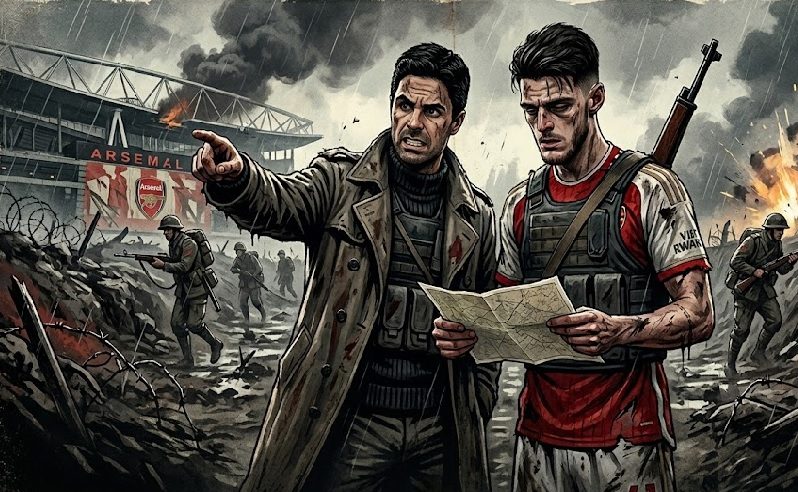
Finding out why Arsenal has lost all its lead to Manchester City. The hard way.
“Paaji, is it over? Just tell me. Is it over?”
Ballwinder Paaji was in the kitchen. Not metaphorically — actually in the kitchen. He was standing over a pot with the expression of a man conducting a culinary post-mortem. I looked at the pot. It did not look like what he had promised when I arrived.
Me Running towards Biryani
“You said biryani,” I said.
“I said biryani,” he confirmed.
“That is not biryani.”
“No.”
“That looks like khichdi.”
He turned to me with the precise expression of a man who needs you to understand something important.
“It is not khichdi either.”
He carried the pot to the table and set it down with the gravity of a man presenting evidence in court.
“What you are looking at,” said Ballwinder Paaji, “is tahiri.”
I looked at the tahiri. The tahiri looked back at me. It was rice, cooked with vegetables, vaguely fragrant, perfectly acceptable as a midweek meal. It was not, by any definition, the layered, dum-cooked, saffron-breathed, sealed-pot biryani that had been under discussion since morning.
“Paaji,” I said, sitting down slowly. “Are we still talking about the rice dish?”
“Manchester City two,” he said, sitting across from me. “Arsenal one.”

All my hopes up in the steam.
“Tell me about the match,” he said, serving himself a portion with the resignation of a man who has made peace with events.
“Arsenal had 41% possession, Paaji. Two shots on target. Two. City had twelve shots, five on target. The goals — City scored in the 16th minute, Arsenal levelled immediately in the 18th — two minutes, Paaji, they took two minutes to respond — and then silence. Forty-seven minutes of silence. And then City scored again in the sixty-fifth and that, as they say, was dinner.”
“Dinner,” Paaji repeated, with a look at the tahiri that suggested he found the word appropriate.
“4 offsides. 12 fouls. 4 substitutions from half-time onwards, all of them desperate. The midfield of Rice, Zubimendi and Ødegaard — combined — produced almost nothing in the final third. And it is not just yesterday. Arsenal have scored three goals in their last five games across all competitions.”
Paaji nodded slowly, prodding the tahiri.
“You know the tragedy of tahiri?” he said.
I had a feeling this was coming.
“Tahiri begins exactly as biryani begins. Same rice, same pot, same kitchen, same intention. You wash the rice. You soak it. You bloom the spices. For the first twenty minutes, if you close your eyes, you cannot tell the difference — the smell is almost identical. There is a moment — a specific, identifiable moment — when biryani and tahiri diverge. Biryani gets the meat. Biryani gets the layers. Biryani gets sealed — dum — and left alone in total faith that the process will deliver what was promised.”
He gestured at the pot in front of us.
“Tahiri does not get sealed. Tahiri gets stirred. Tahiri gets checked, and adjusted, and worried over, and substituted at half-time. And by the end, you have something that smells like biryani, looks vaguely like biryani from a distance, but is fundamentally a different dish. Nutritious. Acceptable. But not what anyone came to the table for.”

Gooners, on their way back after being served tahiri instead of biryani
“Paaji. I need to ask you specifically about Declan Rice.”
He set down his spoon.
“Of course you do.”
“Last season — Player of the Season. Those two free kicks against Real Madrid in the Champions League. The engine, the heartbeat, the dum in Arsenal’s biryani. This season — four goals, five assists across the league. A seven point six average rating — solid. Competent. But yesterday, at the Etihad, in the biggest game of the season, the man was there in body and largely absent in consequence.”

Rice – pulling up his socks last evening.
Ballwinder Paaji looked at the pot for a long time.
“Here is what you must understand,” he said finally. “In biryani, the rice is not the hero. The rice is the medium. The rice carries the saffron, holds the heat, absorbs the marinade, gives structure to everything layered above and below it. The rice does not show off. But if the rice fails — if it is overcooked, if the grains lose their individual texture and collapse into each other — the biryani collapses with it. There is no separating the two.”
“And Rice is overcooked?”
“Rice,” said Paaji carefully, “has been on a very high flame for a very long time. Two seasons of relentless Premier League football. Champions League. England duty. The weight of being the ingredient everything else depends on. And now, in April, when we need each grain to be separate and distinct and fluent — the grains are sticking. The texture is gone. What was last season the perfect medium has become, in this crucial fortnight, something slightly heavy. Slightly slow to the second ball. Slightly less than what the dish requires.”
He paused.
“That is not a criticism. Overcooked rice is not a failure of the rice. It is a failure of timing. Of knowing when to take it off the heat.”
The kind of pressure on Rice to perform.
“But Paaji — is it Rice specifically, or is it Arsenal as a whole?”
“This is the question,” he said, pointing the spoon at me with the energy he reserves for the second layer of an analogy. “And it is the question that separates biryani-thinking from tahiri-thinking. In biryani-thinking, you understand that every ingredient affects every other ingredient. Rice cannot be separated from the dum, from the meat, from the sealed pot. When Declan Rice — the midfielder — was at his peak, Arsenal’s entire structure derived energy from him. Zubimendi pressed harder. Ødegaard found space earlier. The press was coordinated, the transitions were fast, the dish was sealed and cooking correctly.”
He looked at the tahiri.
“In tahiri, because the pot is never properly sealed, each ingredient sits in its own space. The rice is rice. The vegetables are vegetables. Everything is present. Nothing is unified. Arsenal yesterday had the ingredients of biryani — Ødegaard, Rice, Eze, Havertz, Madueke — in a pot that was never sealed. They equalized in the eighteenth minute and instead of sealing the lid and trusting the process, they opened the pot every five minutes to check. And a pot that is opened every five minutes never, ever becomes biryani.”

Arteta after every 90 minutes, for the next 90 minutes
The numbers confirm the dish
City had 59% possession. Arsenal — the supposed title favourites, the team built on defensive solidity and controlled attacking transitions — had 41%. Arsenal have managed just three goals in their last five matches across all competitions, a run that has coincided with a decisive wobble at the top of the table.
The standings: Arsenal 70 points, City 67 — but City with a game in hand. City face Burnley on Thursday. The models give Guardiola’s side an 83.6% chance of winning that fixture — a team that has won four games all season. If City win, the gap is zero. Arsenal’s nine-point lead from one week ago will have become level. In seven days.
Since the final whistle at the Etihad, 67% of bets placed on the Premier League winner market have gone on Manchester City. Guardiola’s April win rate stands at 71.4% — the finest finisher in the history of this competition, peaking, again, exactly on schedule.
“So is it over, Paaji?”

He considered the tahiri. He served himself a second, smaller portion — the portion of a man who has made peace with what is in front of him.
“Arsenal have five games left. They are three points clear. Their remaining fixtures are largely against the bottom half. They face Newcastle next — sixteenth in the table. Wayne Rooney still has them as slight favourites. Danny Murphy believes it may come down to goal difference. Goal.com’s analysts think City will push all the way but ultimately fall just short. Arsenal still control their own destiny. That is not nothing.”
“But?”
“But they set out to make biryani. Three years of Arteta. Three years of almost. Three years of the pot being assembled, the ingredients being right, the kitchen smelling like something extraordinary was on its way.” He gestured at the table. “What we have is tahiri. Edible. Respectable. A dish many teams would be grateful to serve. But the people of north London did not spend twenty-two years waiting for tahiri.”
He stood up, took the pot back toward the kitchen.
“The rice,” he said, at the doorway, “needed to come off the heat two weeks ago. It did not. And now Arteta must serve whatever is in the pot, at the most important dinner of the year, to the most unforgiving guests in English football.”
He turned off the kitchen light.
“Pray the tahiri is enough.”

Arsenal fans. Five games left. Watching Burnley vs City on Thursday.
The prediction — what the sources say:
The gap is three points. City have a game in hand against Burnley, and Guardiola’s April record of 71.4% wins makes him the most dangerous man in football at this precise moment in the calendar. The title race is likely to go to the final day. The majority of expert opinion still gives Arsenal the edge — but only just, and only if the rot stops immediately. Coral still lists Arsenal as favourites to end a 22-year title drought — though the odds are shortening by the hour.
The biryani is not yet lost. But it is not biryani anymore.



 Ballwinder