PBKS & KKR – Two Kinds of Lion Over One Cuppa Chai
Paaji is at the stove.
Ginger — crushed, dropped in with conviction. Cardamom — two pods, no discussion. Saffron — three strands, not four, not two.
Froth rises. He blows it down. Adjusts the flame.
“Paaji. IPL.”
“Talk,” he says. Still facing the stove.
Stove aka The Lab
I tell him about KKR. Highest auction purse — ₹64.30 crore. Cameron Green for ₹25.20 crore, the most expensive foreign player in IPL history. A coalition built to dominate.
Then, before Match 1: Harshit Rana — knee surgery, gone. Pathirana — injured, unavailable. Mustafizur Rahman — released before bowling a single ball. Andre Russell — retired. Jersey number 12, quietly hung on the wall.
What remained was Cameron Green, hunting mostly alone. Nine games later — one win, delivered not by the ₹25.20 crore man but by Rinku Singh, last ball, fine leg, six.
Paaji stirs. Says nothing.
You can’t see me. On the points table!!
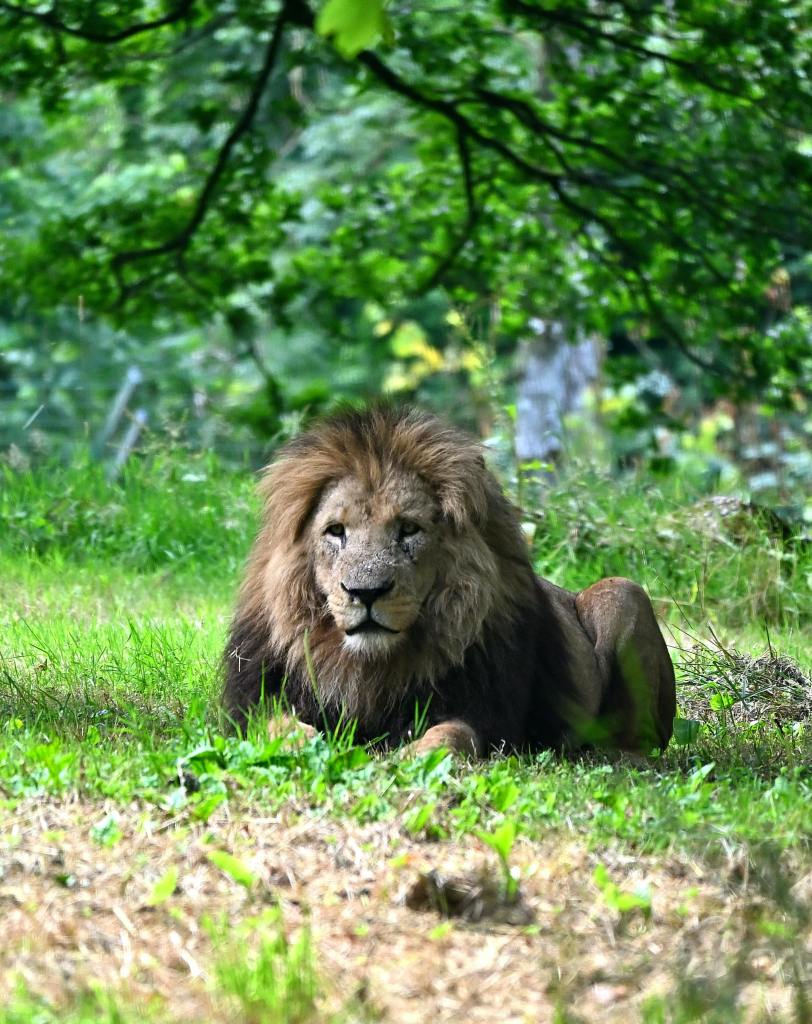
“The African lion,” he says finally. “Full mane. Loud roar — travels five miles. Big pride. Big prey. Big theatre.” He glances at me. “Hunt success rate — twenty-five percent.”
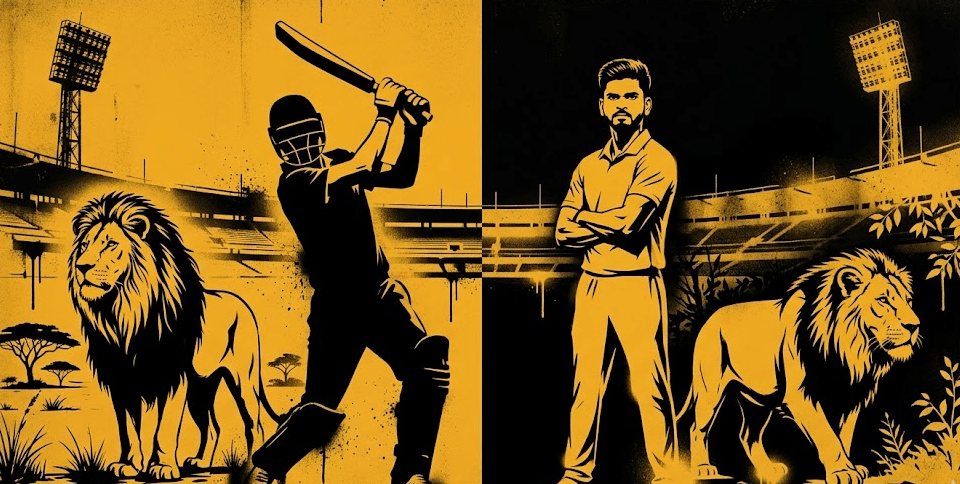
The African Lion – Royalty at the hilt of glory!
He lets that land.
“Three out of four hunts. Nothing.”
“KKR built the African lion pride. Then the pride dissolved before the season. And a lion without his coalition—” he taps the pot “—cannot hunt alone.”
He pulls his phone out. Punjab Kings badge. The lion looking back at us.
“This,” he says, “is not an African lion.”
“Asiatic lion. Indian lion. Only in Gir, Gujarat. Smaller mane — you can see the ears. Softer roar. Smaller pride — two, three, tight unit. No open plain. Forest hunting. Terrain. Each other.”
He turns.
“Same animals. Same trees. Season after season. Hunt success rate — higher. Because they don’t waste energy on theatre.”
“Eighteen years Punjab Kings put this lion on their chest and hunted like the African one. Big names. Big auction. Nine different captains in ten seasons. Nine.” He shakes his head slowly. “Every year — new voice, new philosophy, same confused animals.”
Every other franchise passing by the Punjab Kings in the past.
He blows the froth down again.
“You know what the Asiatic lion never does? Changes its forest every season.”
Then Ponting came. Then Iyer. Twenty-one players retained. Same forest. Same family. Second season, same flame.
Currently unbeaten. NRR plus 1.420. Three points clear.
The Lion where it belongs. Top of the food chain called the points table!
“The Indian lion was once down to twenty animals in the whole world.” He pauses. “You know what saved them? Same forest. Same family. Year after year.”
He pours. Two cups. Hands one across without asking.
I sip.
I sip. With Swag.
The ginger hits first. Then cardamom. Then the saffron arrives underneath everything — quiet, deep, inevitable. I open my mouth to say something about it.
Paaji raises one hand.
“If it were truly that great,” he says, “you would have made the sound.”
I look at him.
He sips.
Suddupaaaaaah.
One eyebrow. Back to the cup.
Outside, a points table is being updated. Punjab Kings at the top.
The badge was never wrong.
They just spent eighteen years trying to be the wrong lion.
Documentaries are about bringing a true event and the story around it in the words of those who have witnessed it. That is a broad enough definition and on such a definition, usually a documentary is not consumed. The just released docuseries- “The greatest rivalry-India vs Pakistan” has left us in the lurch of what could have been an intense experience of witnessing the emotions and an exploration of the feelings or impact of those feelings. The feeling was akin to an India Pakistan match drawn by rain- all the emotions and nerves going down the drain.
Growing up as an Indian Punjabi migrant who is overtly patriotic and even more when it is against Pakistan, the docuseries does not capture well the emotion behind it. The story is not about the hospitality that Indians and Pakistanis display for each other. The story should rather have been that despite the hospitality, how intense is the rivalry. Unfortunately, this theme did not reflect well enough throughout the series. If you remember watching the Indian tour of Pakistan 2004 live, (which was incidentally called the “Friendship Series”), there was a very famous ad campaign shot by Pepsi around the series. In one of those ads, Ganguly is directing Md. Kaif and Zaheer Khan to pick and place the Friendship series board and Kaif hammers down the bottle of Pepsi that displaces the “Friendship” from the board. You feel like wanting to repeat the hammering down gesture quite a few times while watching the docuseries.
In fact, the most interesting bit that was more intriguing was the story of the Reverse-swing and its impact in the world of cricket. Ironically, as a fan of the greatest rivalry, I was bowled on a “reverse swing” delivered by the docuseries, which was somehow mixed with a “slower-one”, and I just wished I could have read it from a distance to respect it with a quintessential “leave”.
Unfortunately, the magnitude of the rivalry could not be justified completely. Neither from the Indian nor the Pakistani side in terms of politics, economics, engagement when it comes to the greatest rivalry of the sporting history. Ashes was mentioned, but there was no clear representation as to how and when the Ashes were a thing of the past and this rivalry especially with humongous diaspora and no love lost between the sparring nuclear nations could succeed to a houseful match anywhere in the world. The toss of an India and Pakistan match alongwith the pitch report and the opening remarks of ex-cricketers has more content than the documentary itself.
If the mission of this docuseries is to give a primer to the neutral viewers across the world who are oblivious to the world of cricket and what goes on in making a rivalry, then some better context is required in terms of explaining the scale with comparisons to perhaps a political Greece-Turkey, Serbia-Bosnia, Armenia-Azarbaijaan, Iran-Iraq examples. Some outside context of either the politics or the “arch” in the arch rivalry needs further elaboration. Otherwise, it feels like a stereotype to anybody who watches the series about the sport or its greatest rivalry. They would end up thinking this rivalry is about an Indian batsman crowned as the Sultan of Multan and a particular fast Pakistani bowler Shoiab Akhtar who got the batting greats like Sachin Tendulkar and Rahul Dravid out at the Eden Gardens in his debut test series.
The documentary should have called itself “The last tours of India Pakistan” or “Sehwag and Akhtar – The greatest modern day rivalry” (It was not even that much of an individual rivalry comparable to Sachin and Shane Warne or Sachin and Mcgrath but nevertheless). It was refreshing to have the perspective of Inzamam ul haq and Miandad. However, there was an overall lack of energy. There seemed a sort of haste to get the docuseries out which left more to the imagination than what the viewer should have actually witnessed. Exactly, like this review.
India lost yet another test cricket series abroad. Ballwinder explains elephant and its tail over a cup of Black Ivory Coffee.
“And yet again Indian Cricket team loses a test series abroad”, I said with a quick glance towards Ballwinder Paaji while swapping the sports channel to the one where Premier League was on.
“How can you claim to be the best batting line up in the world when you collapse before such low totals?”, I looked again at Ballwinder paaji. “Who is responsible for such performances?”, I was on a rant, hoping for some response. It had been long, I did not realise what exactly was I asking for. Ballwinder paaji was busy burning the fresh Arabica beans for his double/triple shot espresso. But he was listening.
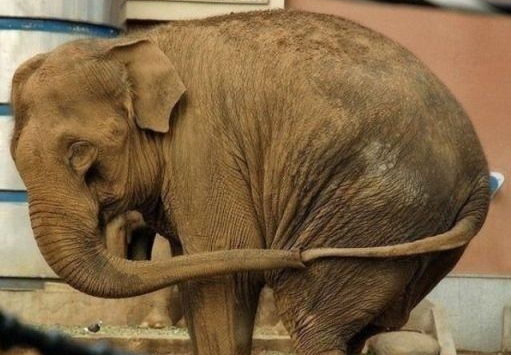
“You sire, are in for a ride. Perhaps an elephant ride”, I said to myself. The most exciting thing about an elephant is its size, its trunk, its tusk. Why would anybody even think about its tail. Who has ever even thought about its tail.
Then there is Ballwinder. Ballwinder would tell me not only the significance of an elephant’s tail, but also its relevance in the context of Indian cricket team losing yet another cricket series abroad. Now I don’t even bother asking the obvious question like “Ballwinder Paaji, What on earth just happened? I just commented on the consistent claims of Indian team to be the best in the world despite losing abroad, series after series??”. But I did not ask. I just patiently waited for Ballwinder to address the “elephant” in the room. He knew what I was thinking. He looked at me with a slight smile and only broke eye contact when his coffee did the magic for him.
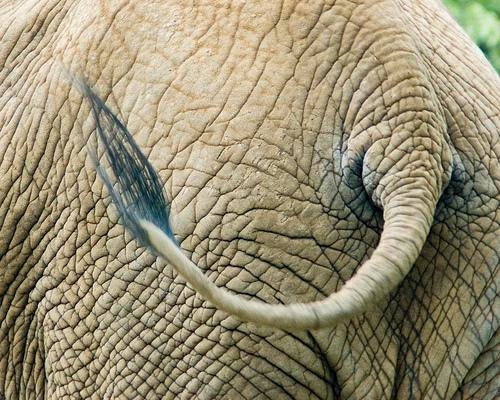
“Elephant is such a majestic animal. You are in its absolute awe. That trunk, the tusk, you are blown away. A creature of magnanimity, true class. And then there is its tail. A tail which does not go with its size, style, trunk or tusk. Something that is there to give it acceptance in the jungle. Everybody’s got one. Well, elephant should also have it. What’s its purpose. For example, look at a cheetah, its tail helps as rudder when it attacks. Look at a crocodile, its tail gives a torpedo effect in water. We, homo sapiens, did not have any use of it, so it vanished. Poor elephant is stuck with this tail. Just as a part of nature’s contract. Quite a price to pay, must I say.
“That’s interesting, Ballwinder Paaji”, I said with intrigue. I actually was. Useless, elephant’s tail. As enlightening as it sounded, I still sought an answer to my question. “I understand this much, that you are referring to the Indian cricket team as an elephant. Its character can be compared to the class that an elephant belongs to. But what’s with the tail? Who is the tail? Why is the Indian team losing series after series”, I had to address the “elephant” in the room.
“The tail end of the Indian batting is the elephant’s tail”, said Ballwinder in a firm voice. A voice that sounded as if coffee was still somewhere there in the throat. I was shocked. I was taken aback. Not as much by the voice as by his reply. “The tail end of Indian batting, you mean the bowlers? They are not supposed to be batsmen”, I was enraged. At the tip of being offended.
“Indian bowlers are not tail end batsmen Ballu Paaji, they are bowlers. We have to play them else the English would never have gotten out. In fact, Ballu Paaji, they got the England batting limited to such low scores! Here (England) as well as against South Africa! They did their job!”, I said, now officially being offended.
Ballwinder was unmoved. He was not at all moved by my reaction. Somewhere he knew that truth is as bitter as coffee. Not everybody can handle it bitterness the first time they sip it. One has to get used to such bitterness called the truth to relish its flavour and slowly come to terms with one’s mind and soul. He continued to sip his coffee, while my blood boiled in ignorance.
“I understand your angst”, said Ballwinder Paaji while trying to patronise me. “But this is the bitter truth. Indian batting is as majestic as an elephant. You have to, have to admire it. You don’t have any choice. You just can’t criticise. Someday you might admire its trunk (Kohli), someday its tusk might stand out (Pujara), maybe never as a whole, but you can never condemn the elephant in its totality (The “grand” top order batting performance). Because you just cannot question the beauty of the elephant. Everybody ends up disgusted with the tail, never with the elephant. Who is acknowledging the fact that the Indian bowling performance has been unprecedented, that they have been successful in limiting the opposition batting to such low scores in the recent test matches? If the bowlers themselves cannot fend the challengers’ bowling attack, play between the gaps, keep rotating the strike, hit the odd one out for a boundary, and reduce the bat-pad gap, well then, they are as efficient as an elephant’s tail.”
Although I could not even raise them, Ballwinder Paaji opened my eyes. I wish I never had to find out the truth. Not at least this way.
Ballwinder goes technical. Happiness in England and Sadness across two continents.
“Paaji, where have you been?”, I asked,”I have been looking for you since the Kroos rescue.”
Ballwinder was indifferent to my question, rather more focused in dressing his nachos with diverse toppings. He replies ” I was busy.” Clearly, one could see doing what..
“Either ways Paaji, 6-1! 6 goals by England in a World Cup finals! Where the first match nearly gave everybody jitters and now just look at them. Hell! even the English cannot believe this! Must be the happiest day in their lives after a very long time”, I said with a little sense of rejoice.
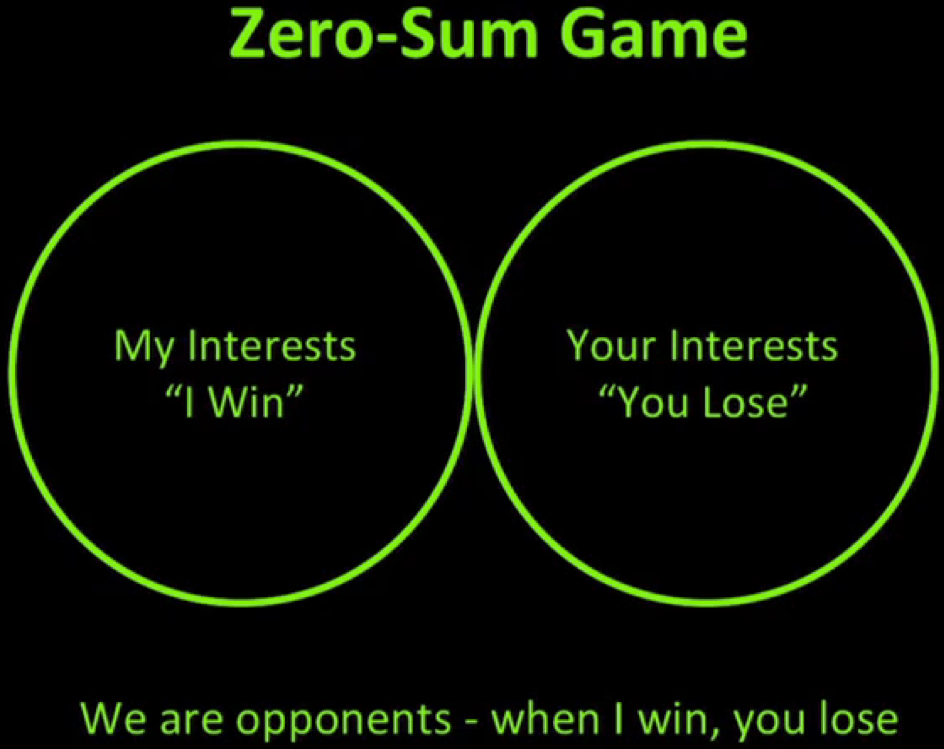
Ballwinder smiles, without breaking any concentration of arranging his plate of nachos “It was a true depiction of Zero Sum game. Do you know what a Zero-Sum game is? ”
Wait a second. “6-1=5 ; How is it sum zero?” I realized while rechecking the score of England Panama. I asked while gulping my fear of the known..”But ….How…?”
Ballwinder sits down with his platter of Nachos, picks up a Nacho and sweeps it across the dip and starts munching. He then ordains,
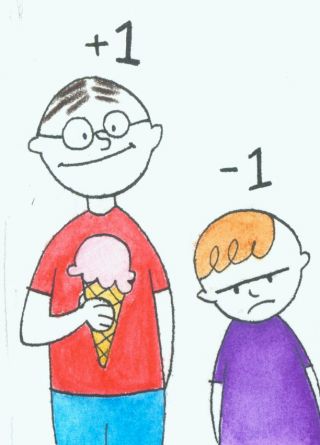
“When you win against someone. You are happy. The one who loses is sad. Thereby maintaining the overall balance of happiness and sadness. Your happiness and your opponent’s sadness when added gives you a Zero-Sum. English fans were deprived of this happiness and pleasure for ages. They would always witness the opponents celebrating on their loss. Imagine the amount of grief and sorrow they must have been bearing for all this while and just today, they have virtually given it all back with compounding interest. Countries from two continents were taken down by the English. The magic number being 5”
“What exactly does that have to do with English fans who were surprised by their enormous victory in the World Cup last evening!? And two continents? Which two continents? North America and Central America?? And what is this magic number 5”, I won’t surrender this time. I will clarify all my existential doubts.
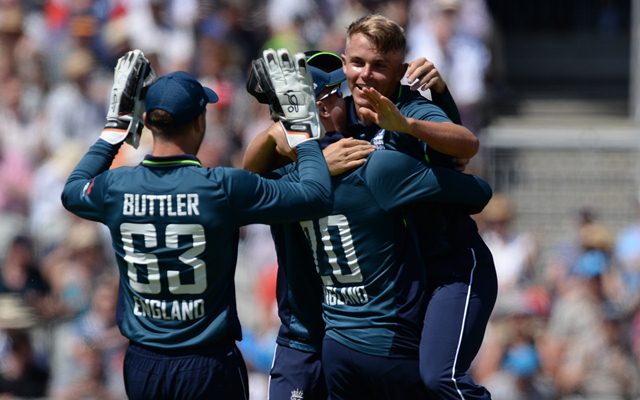
“Not only the football fans, but even the cricket fans of England were happy. Then there were people who were double happy for winning at both the sports thereby transferring their age old sorrows of losing, to the two continents which are diagonally opposite to each other. And these victories came at the margin of 5 each. Therefore maintaining the Zero-Sum game in the global context.”
“But Ballwinder Paaji, do you really think that just this one day can balance all the disappointment and heart breaks of English fans for all these years? I am sure it can compensate the last decade but what about the decade before that?” I again asked in my innocence.





































 Ballwinder